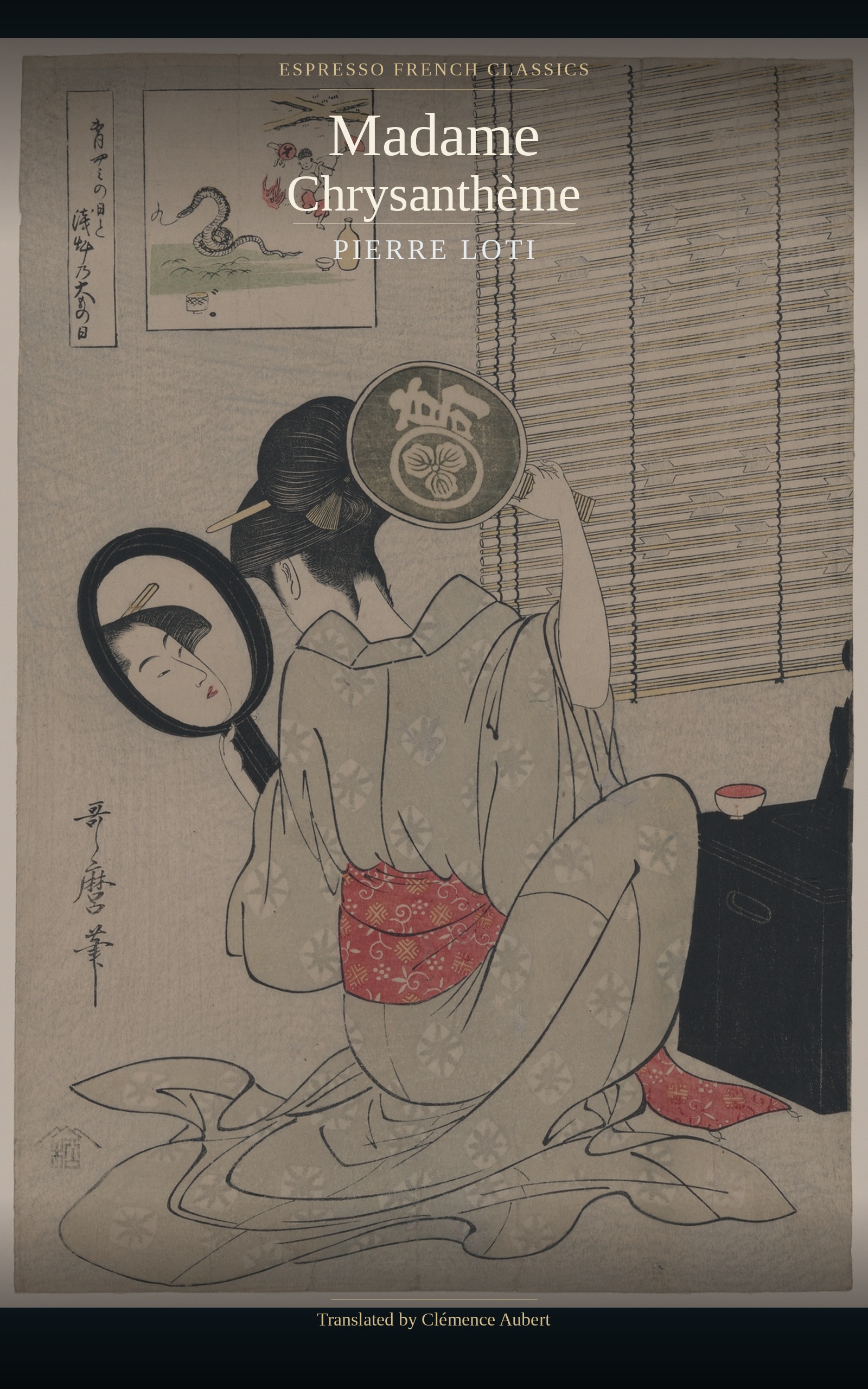
Espresso French Classics
Madame
Madame
Chrysanthème
Madame Chrysanthème
Translated from the French by Clémence Aubert · Introduction by Idara Crespi
Madame Chrysanthème
Translated from the French by Clémence Aubert · Introduction by Idara Crespi
“Aubert’s insistence on accuracy is today and in this context entirely appropriate.”
Featured in OperaWire
In the summer of 1885, French naval officer Pierre Loti arrived in Nagasaki on a three-month posting and arranged, following local custom, to rent a small house and a temporary wife. Madame Chrysanthème is the novel he made from that arrangement. Part journal, part portrait, written in a voice of such cool, precise attention that it is sometimes mistaken for indifference. It is not.
Loti watches everything: the paper screens, the painted fans, the coins his wife tests between her teeth on the last morning. What he cannot quite see is Chrysanthème herself. She remains at the centre of the book as an absence, observed in minute detail, never quite reached. The novel’s discomfort is the point.
Madame Chrysanthème was one of the most widely read French novels of its era. From it descended a short story, a Broadway play, and finally Puccini’s Madama Butterfly. The last new English translation we can trace appeared in 1905.
This edition includes a translator’s note by Clémence Aubert, a glossary of Japanese terms, and historical notes on Loti, the 1885 Nagasaki posting, and the novel’s afterlife in opera and theatre.
Pierre Loti was the pen name of Julien Viaud (1850–1923), a French naval officer who eventually rose to the rank of captain and spent decades crossing between the Mediterranean, Asia, the Pacific, and the Atlantic on postings that gave him the material for his novels. He was one of the most widely read French writers of the late nineteenth century. Not despite his naval career but because of it. He went where other novelists could not.
His books drew directly on his postings: Tahiti, Senegal, Turkey, Morocco, Brittany, and Japan each produced a novel. Madame Chrysanthème, published in 1887 after his 1885 Nagasaki assignment, became perhaps his most consequential work, not because of its literary reputation (which remained contested) but because of what it generated. John Luther Long’s short story of 1898, David Belasco’s play, and at last Puccini’s 1904 opera all trace their origin to Loti’s novel. He was elected to the Académie française in 1891.
Loti’s prose style is hard to characterise without reading it. He writes about surfaces with great precision: what things look like, how they smell, the quality of light in a particular city at a particular hour. The people around him are another matter. From them he keeps a distance that his admirers called honesty and his critics called coldness. The argument has never been settled. Madame Chrysanthème is the place to begin.
Pierre Loti’s Madame Chrysanthème turns on an effect that is easy to lose: a narrator who, page by page, manages to condemn himself without quite meaning to. Producing a contemporary English that stays with that irony, rather than rescuing the narrator from himself, is the project that brought Clémence Aubert to EPH. She lives in Lyon. The body of her work has been 19th-century French fiction, Maupassant and Loti and Zola, and her conviction is that these novels are stranger and less comfortable than their English reputations suggest, and better for being read that way. Madame Chrysanthème is her first translation for Espresso Publishing House.
This Espresso Publishing House edition is the first new translation of Madame Chrysanthème since Laura Ensor’s Victorian version of 1897. It includes an original introduction by Idara Crespi placing Loti and the novel in their literary and historical context; a translator’s note by Clémence Aubert on the specific challenges of his prose style; a glossary of Japanese terms and phrases used throughout the text; and historical notes on Loti’s Nagasaki posting and the chain of adaptations the novel inspired.
Kindle and paperback editions are available now.
“As an early and formative work of a genre that is still with us, it deserves an up-to-date translation. Aubert’s insistence on accuracy is today and in this context entirely appropriate.”
— Peter Gordon, Asian Review of Books, July 2026; reprinted in OperaWire, August 2026
“Espresso Publishing House has just published a wonderful new English translation of Pierre Loti’s classic novel Madame Chrysanthème (1887) by Clémence Aubert, and I had the privilege of reading it.”
— Salvador Lopez Rivera, French Literature For All, July 2026
“The translator of this brand new English edition did a nice fluid work, it really felt like reading a diary, and she certainly didn’t try to minimize Loti’s disdain and condescension.”
— Emma Cazabonne, Words and Peace, July 2026
The California Review of Books called it “an elegant new translation by Clémence Aubert,” one that “gives us an unvarnished view of this late nineteenth-century blockbuster and the ‘influencer’ author who created such an enduring myth of Japan.”
— Linda Lappin, California Review of Books, September 2026
Madame Chrysanthème was also the subject of a July 2026 feature in OperaWire, on the novel’s descent into Madama Butterfly and what the opera changed along the way.
Reviewed in The Japan Society Review (Japan Society, London), June 2026, by Miki Hosaka-Green.
Pierre Loti · Translated by Clémence Aubert · Available now
$25 or more, 20% off with code EPHREADER20.