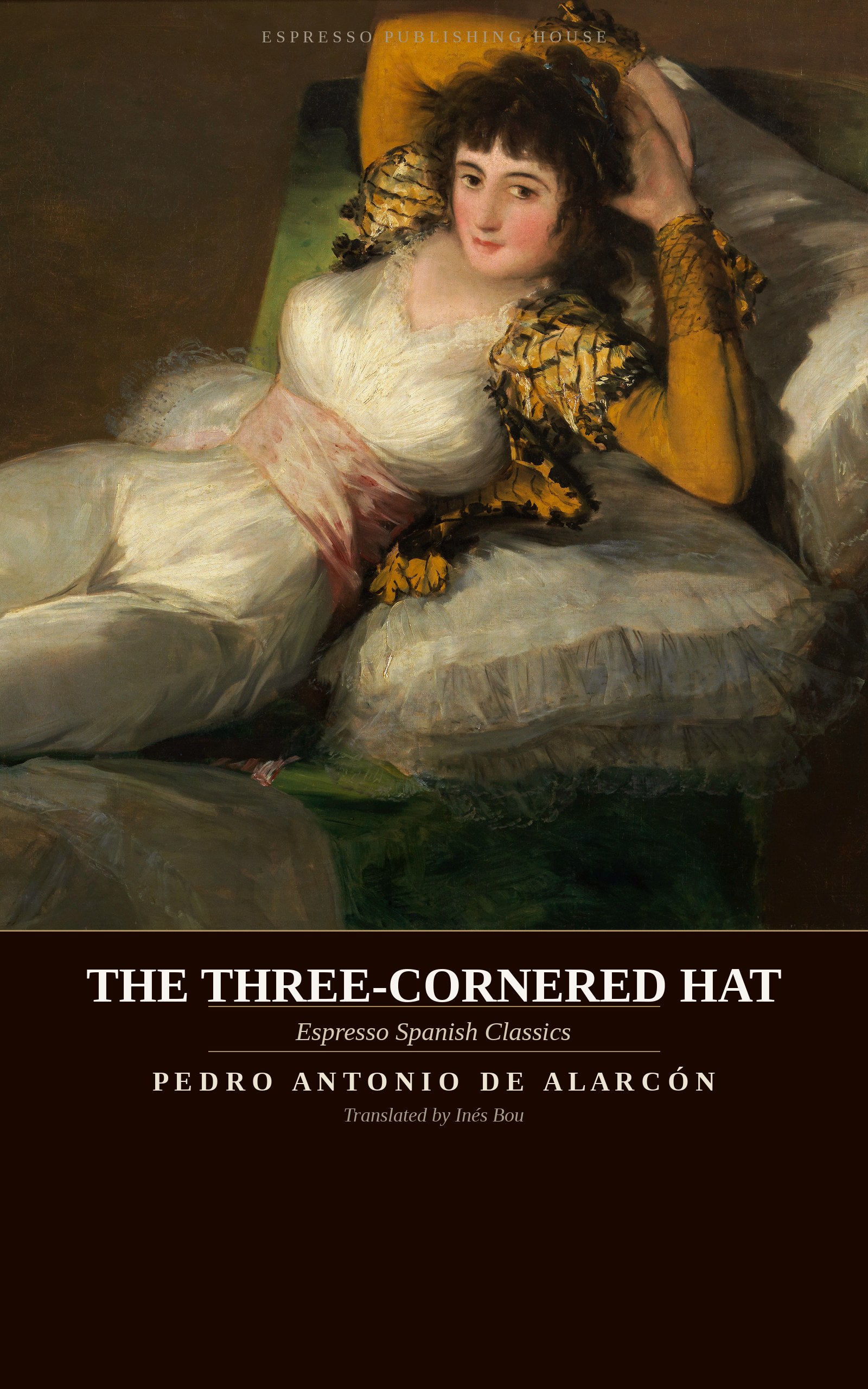
Espresso Spanish Classics
The Three-Cornered
The Three-Cornered
Hat
El sombrero de tres picos
Translated from the Spanish and introduced by Inés Bou
El sombrero de tres picos
Translated from the Spanish and introduced by Inés Bou
Andalusia, early nineteenth century. His Worship the Corregidor is the law, at least so long as he keeps his hat on his head. When the magistrate comes calling at the mill on the road outside the city to pursue the beautiful miller’s wife, neither the authority of his three-cornered hat nor the splendour of his scarlet cloak will protect him from Tía Frasquita’s wit or her husband’s cunning.
Pedro Antonio de Alarcón’s best-known work of Andalusian folk comedy was the inspiration for Manuel de Falla’s 1919 ballet, designed by Picasso, choreographed by Massine, and produced by Diaghilev for the Ballets Russes. The ballet is famous. Fewer people know that Manuel de Falla built it on a short Andalusian comedy by Pedro Antonio de Alarcón. This is that book.
This edition includes an original introduction by the translator and a full set of historical notes on Alarcón, the Falla ballet, and the Andalusian oral tradition from which the story emerges.
Pedro Antonio de Alarcón (1833–1891) was one of the central figures of nineteenth-century Spanish literature: a novelist, journalist, and traveller whose career spanned the turbulent decades of liberal reform, revolution, and Restoration that defined the era. Born in Guadix, in the Granada region of Andalusia, he came to writing through journalism and found his literary voice in the south’s oral traditions, folk stories, and village life.
El sombrero de tres picos, published in 1874, is his most enduring work. A short comic novel drawn from an Andalusian folk tale that had circulated for generations. The story’s lightness and precision made it beloved on first publication and irresistible to later artists. Manuel de Falla’s 1919 ballet brought it to international stages, with sets and costumes designed by Pablo Picasso and choreography by Léonide Massine for Sergei Diaghilev’s Ballets Russes.
The novel has been translated into English before. This Espresso Publishing House edition is a new translation made directly from Alarcón’s Spanish.
The Three-Cornered Hat is not a difficult book. It is a delight. But it is easy to flatten. The novel lives in its voice: brisk, warm, comic in a way that requires precise timing and a light hand. Translate it too literally and the wit goes heavy; domesticate it too freely and the Andalusian setting, the oral folk-tale energy, the social texture of the characters all dissolve into generic period fiction.
There is a way of reading that comes from growing up between two languages: the habit of noticing, instinctively, when a word is doing the work of its setting and when it has been imported from somewhere it does not belong. Inés Bou grew up in Barcelona between Catalan at home and Castilian everywhere else, and the habit was already in place by the time she started thinking about literature. She has applied it, since then, to 19th-century Spanish fiction. Most insistently to Emilia Pardo Bazán. Pardo Bazán is Galician, and the world of Los Pazos de Ulloa and La madre naturaleza is the wet green northwest: folk religion, regional Catholicism, and a social order that had almost nothing to do with anything Parisian. Read her without that and you get a novel that could have been set anywhere in 19th-century Western Europe. That is not the book she wrote. The Three-Cornered Hat is Inés’s first translation for Espresso Publishing House; Sunstroke: A Love Story, her second.
This Espresso Publishing House edition is a new translation made directly from the original Spanish source text. It includes an original introduction by Inés Bou and a full set of historical notes on Alarcón, the Falla ballet, Picasso’s designs, and the Andalusian oral tradition that gave rise to the story.
Available in Kindle ebook and paperback.
“If the result of seduction is pleasure, it is translator Inés Bou who should be most commended for her blissful rendition.”
— Sonakshi Srivastava, Asymptote, August 2026
“I’d recommend this short novella as a quick, light-hearted story that also has plenty of depth for those who want to look for it.”
— Andrew Blackman, July 2026
Pedro Antonio de Alarcón · Translated by Inés Bou · Published May 2026
$25 or more, 20% off with code EPHREADER20.