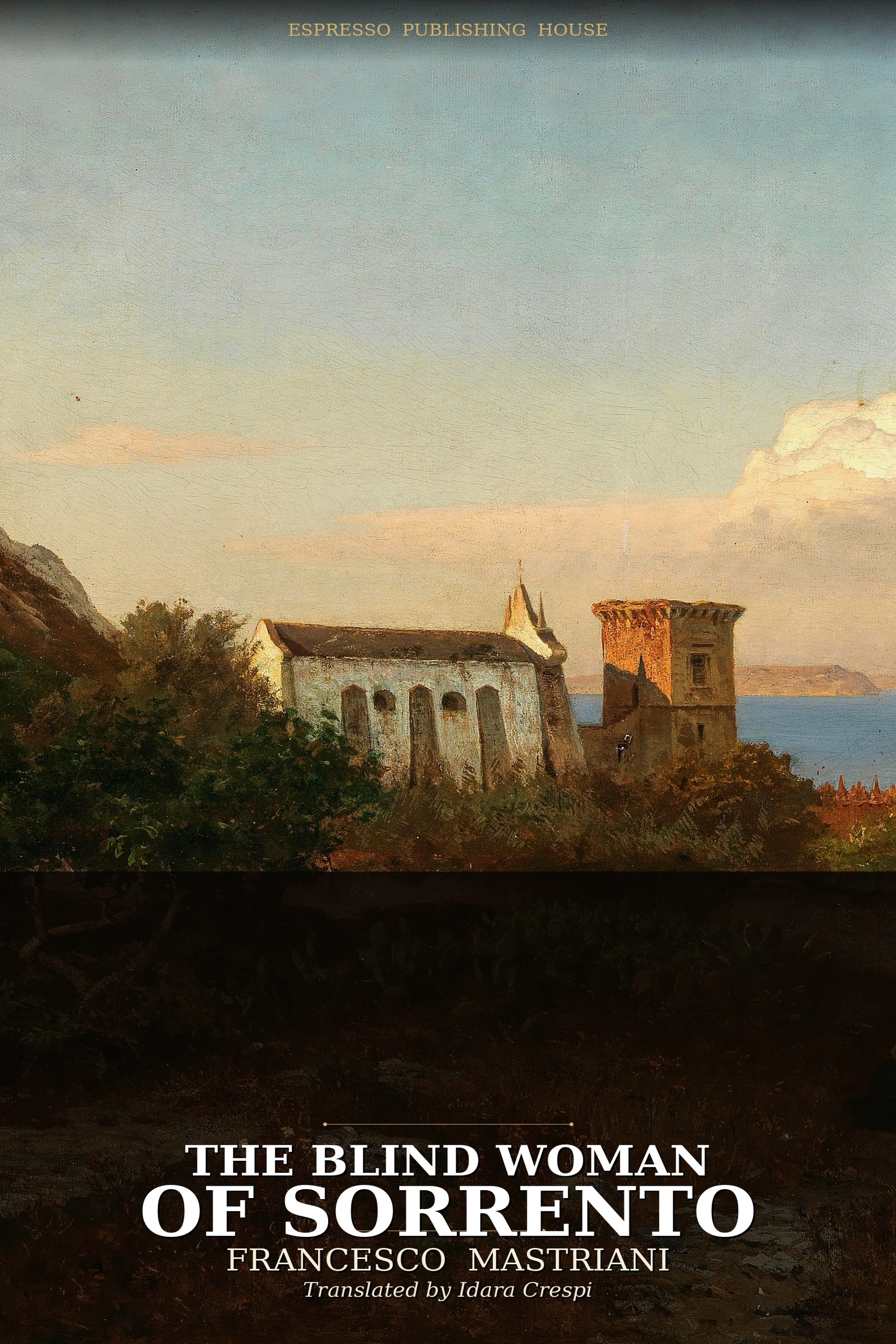
Espresso Italian Classics
The Blind Woman
The Blind Woman
of Sorrento
La Cieca di Sorrento
Translated from the Italian and introduced by Idara Crespi
La Cieca di Sorrento
Translated from the Italian and introduced by Idara Crespi
“I thoroughly enjoyed reading this book and was entertained by it from beginning to end.”
Featured in Reading in Translation · CrimeReads (Lit Hub) · newitalianbooks (Treccani)
Francesco Mastriani’s La Cieca di Sorrento was one of the most widely read Italian novels of the nineteenth century. Serialised, reprinted, staged as opera, beloved by generations of Neapolitan readers. We can trace no English translation of it before ours.
The novel centres on Gennariello, a young man of uncertain parentage raised in poverty, who falls in love with a blind woman of arresting beauty. Their fate becomes entangled with the secrets of an aristocratic family: identity, inheritance, crime. Mastriani’s Naples is rendered with social precision and moral charge, a city where the distance between wealth and want is measured in the space of a street.
This edition includes an original introduction by the translator placing the novel and its author in their literary and historical context.
Francesco Mastriani (1819–1891) was one of the most prolific and widely read novelists of nineteenth-century Italy. Born and raised in Naples, he spent his career writing for the city’s popular press, producing serialised fiction that reached readers of every social class. His novels were adapted for the stage, reprinted across the peninsula, and read by the same audiences who were reshaping Italian literature in the years before and after unification.
Mastriani wrote in the tradition of popular realism that produced Eugène Sue’s Les Mystères de Paris and the great serial fiction of the century. His Naples, though, is distinctly his own: socially acute and morally charged. He depicted the city from the street upward, and the lives of the poor and the dispossessed with an attention that was unusual for the time.
Despite his enormous popularity in Italy, his work has remained almost entirely unknown to English-language readers. The Blind Woman of Sorrento is the first of his novels to appear in English translation.
Idara Crespi was born in Milan and grew up between Italy and Canada. She studied Journalism at the Southern Alberta Institute of Technology in Calgary, a practical education oriented toward readers rather than disciplines, and came to translation through her work writing about arts and culture. She was reviewing an Italian novel, and by the end of the piece she wanted to hear the book in English the way she had heard it in Italian. When the review was done, she translated the novel herself. Espresso Publishing House grew from that project.
Her work begins with a question that guides everything Espresso Publishing House does: which novels celebrated in their original languages have never been adequately translated into English? The Blind Woman of Sorrento is her first published translation.
This Espresso Publishing House edition is a new translation made directly from the original Italian source text. It includes an original introduction by Idara Crespi placing Mastriani and La Cieca di Sorrento in their literary and historical context: the Naples of the Risorgimento, the tradition of Italian popular serialised fiction, and the novel’s afterlife as opera and stage adaptation.
Available in Kindle ebook and paperback.
Featured Essays
“The Long Silence: Francesco Mastriani in English Translation”
— Idara Crespi, newitalianbooks (Treccani), June 10, 2026
“Introducing Espresso Publishing House and The Blind Woman of Sorrento”
— Idara Crespi, Reading in Translation, May 11, 2026
“The Great Lost Gothic Novel of Italian Romanticism”
— Idara Crespi, CrimeReads (Lit Hub), April 28, 2026
Reader Reviews
“I thoroughly enjoyed reading this book and was entertained by it from beginning to end.”
— She Reads Novels, April 2026
Francesco Mastriani · Translated by Idara Crespi
$25 or more, 20% off with code EPHREADER20.