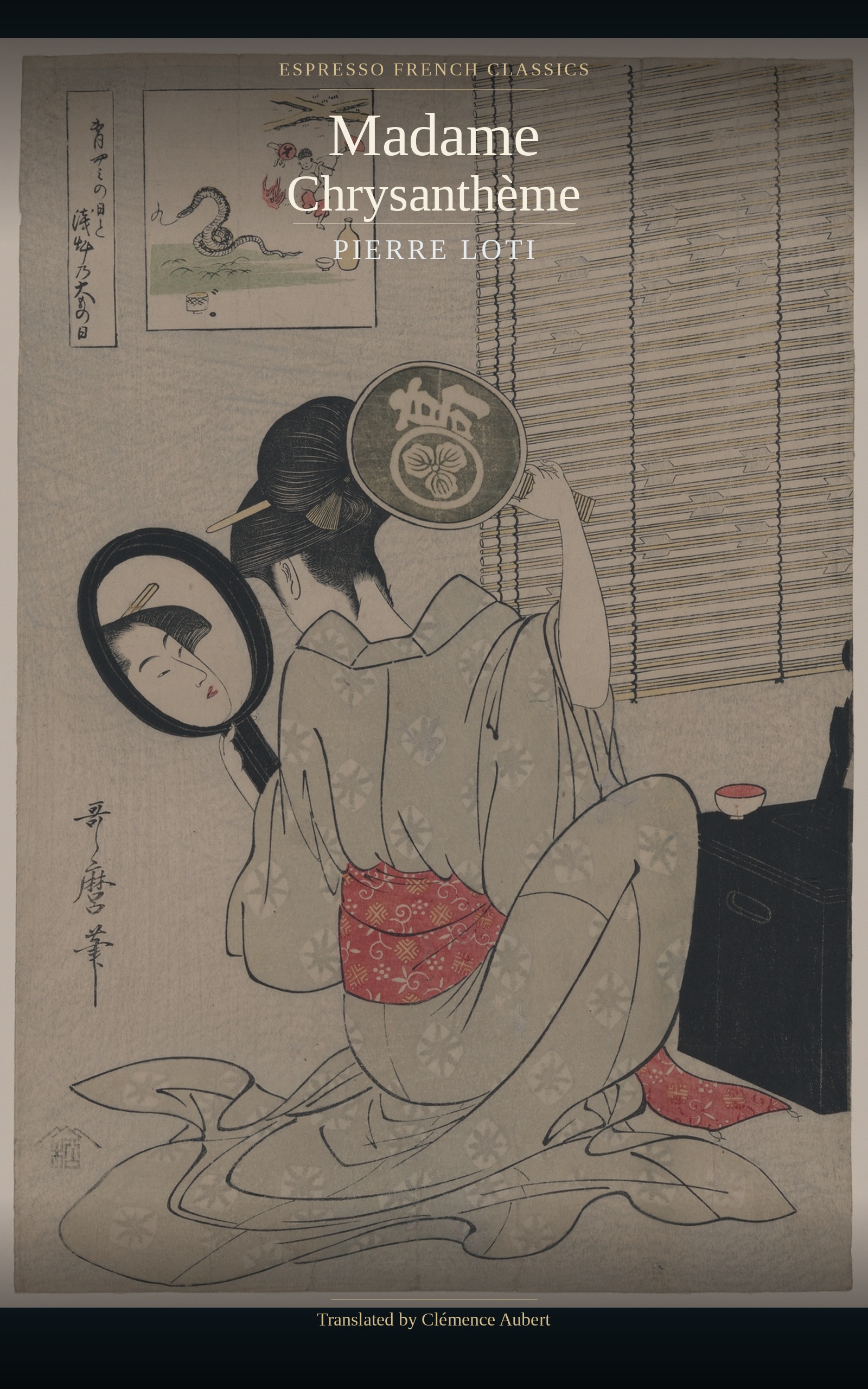
Madame Chrysanthème July 2026
Madame Chrysanthème · Pierre Loti, 1887
Translated by Clémence Aubert
In the summer of 1885, French naval officer Pierre Loti arrived in Nagasaki on a three-month posting and arranged, following local custom, to rent a small house and a temporary wife. Madame Chrysanthème is the novel he made from that arrangement: part journal, part portrait, written in a voice of such cool, precise attention that it is sometimes mistaken for indifference. It is not. Loti watches everything: the paper screens, the painted fans, the coins his wife tests between her teeth on the last morning. What he cannot quite see is Chrysanthème herself.
The novel reached Paris in 1887 and made Loti one of the most widely read French novelists of his era. It set in motion a chain of adaptations that ended in Puccini's Madama Butterfly: a short story, a Broadway play, an opera. This is its first new English translation in over a century.
This edition includes a translator's note by Clémence Aubert, a glossary of Japanese terms, and historical notes on Loti, the 1885 Nagasaki posting, and the novel's afterlife in opera and theatre.
Paperback edition available July 2026.