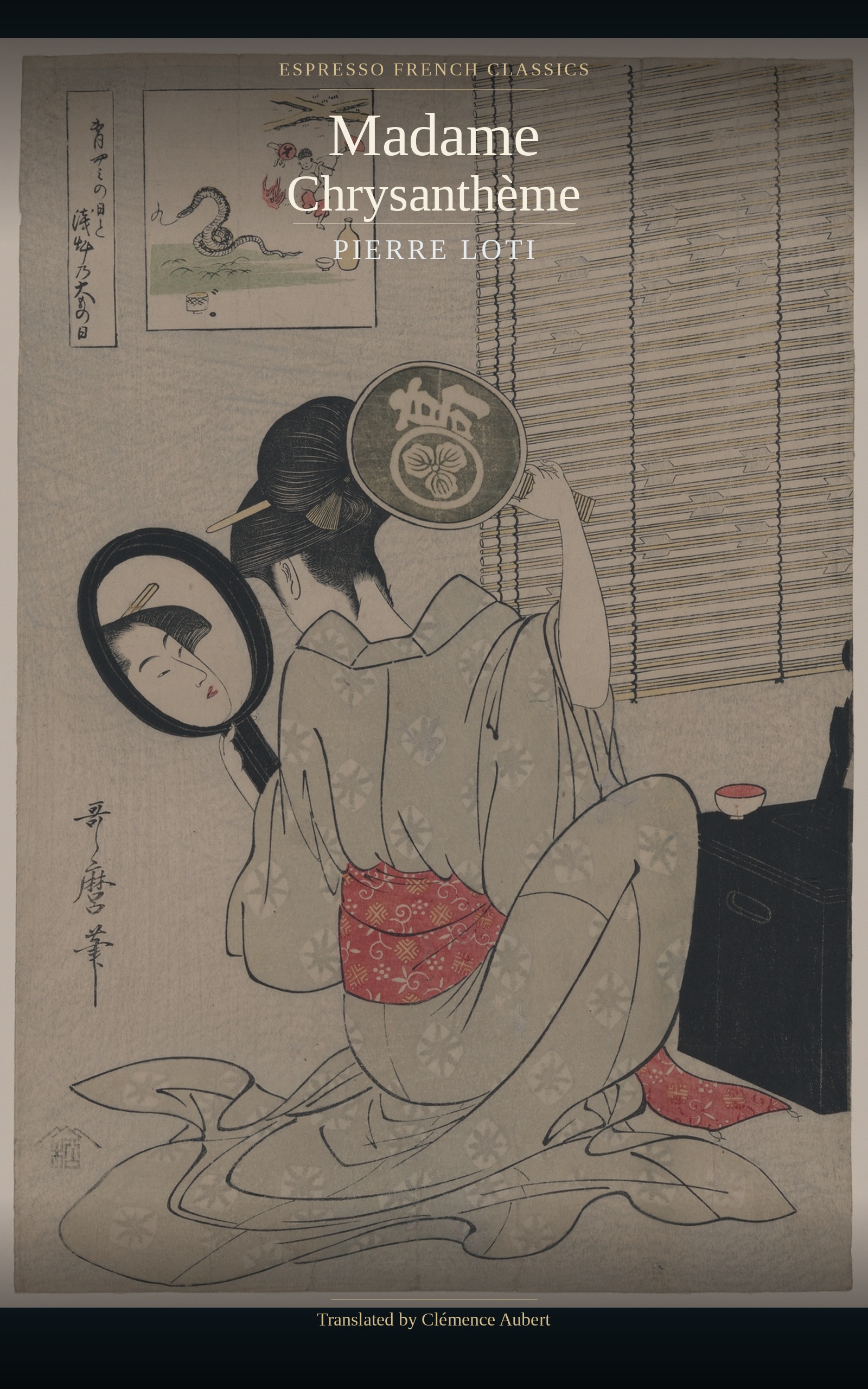
Espresso French Classics

Pierre
Loti

Julien Viaud, 1850–1923

A life at sea

Pierre Loti was the pen name of Julien Viaud (1850–1923), a French naval officer who eventually rose to the rank of captain and spent decades crossing between the Mediterranean, Asia, the Pacific, and the Atlantic on postings that gave him the material for his novels. He was one of the most widely read French writers of the late nineteenth century. Not despite his naval career but because of it. He went where other novelists could not.

His books drew directly on his postings: Tahiti, Senegal, Turkey, Morocco, Brittany, and Japan each produced a novel. Madame Chrysanthème, published in 1887 after his 1885 Nagasaki assignment, became perhaps his most consequential work, not because of its literary reputation (which remained contested) but because of what it generated. John Luther Long’s short story of 1898, David Belasco’s play, and at last Puccini’s 1904 opera all trace their origin to Loti’s novel. He was elected to the Académie française in 1891.

Loti’s prose style is hard to characterise without reading it. He writes about surfaces with great precision: what things look like, how they smell, the quality of light in a particular city at a particular hour. The people around him are another matter. From them he keeps a distance that his admirers called honesty and his critics called coldness. The argument has never been settled. Madame Chrysanthème is the place to begin.


Loti in English

Many readers meet Loti’s story through what came after it. Puccini’s Madama Butterfly is the version people know, and one of its roots is a naval officer’s account of one summer in Nagasaki. This edition goes back to that account and translates it as he wrote it: the precision, the distance, the narrator who never quite sees the woman he describes. Clémence Aubert leaves the coldness where Loti put it, and the notes follow the book out into the opera house.


Loti in the Espresso French Classics

Madame Chrysanthème

From The Journal

Why We Begin with Loti
The literature of the French observer abroad, translated without correcting the author.

Keeping Loti Cold
Why we kept Loti’s coldness, and refused to make his narrator easier to like.


Reviewed in

Peter Gordon, Asian Review of Books, July 2026

Miki Hosaka-Green, The Japan Society Review, Issue 113, June 2026

Linda Lappin, California Review of Books, September 2026

David Salazar, OperaWire, July 2026

Emma Cazabonne, Words and Peace, July 2026

Salvador Lopez Rivera, French Literature For All, July 2026

All press →