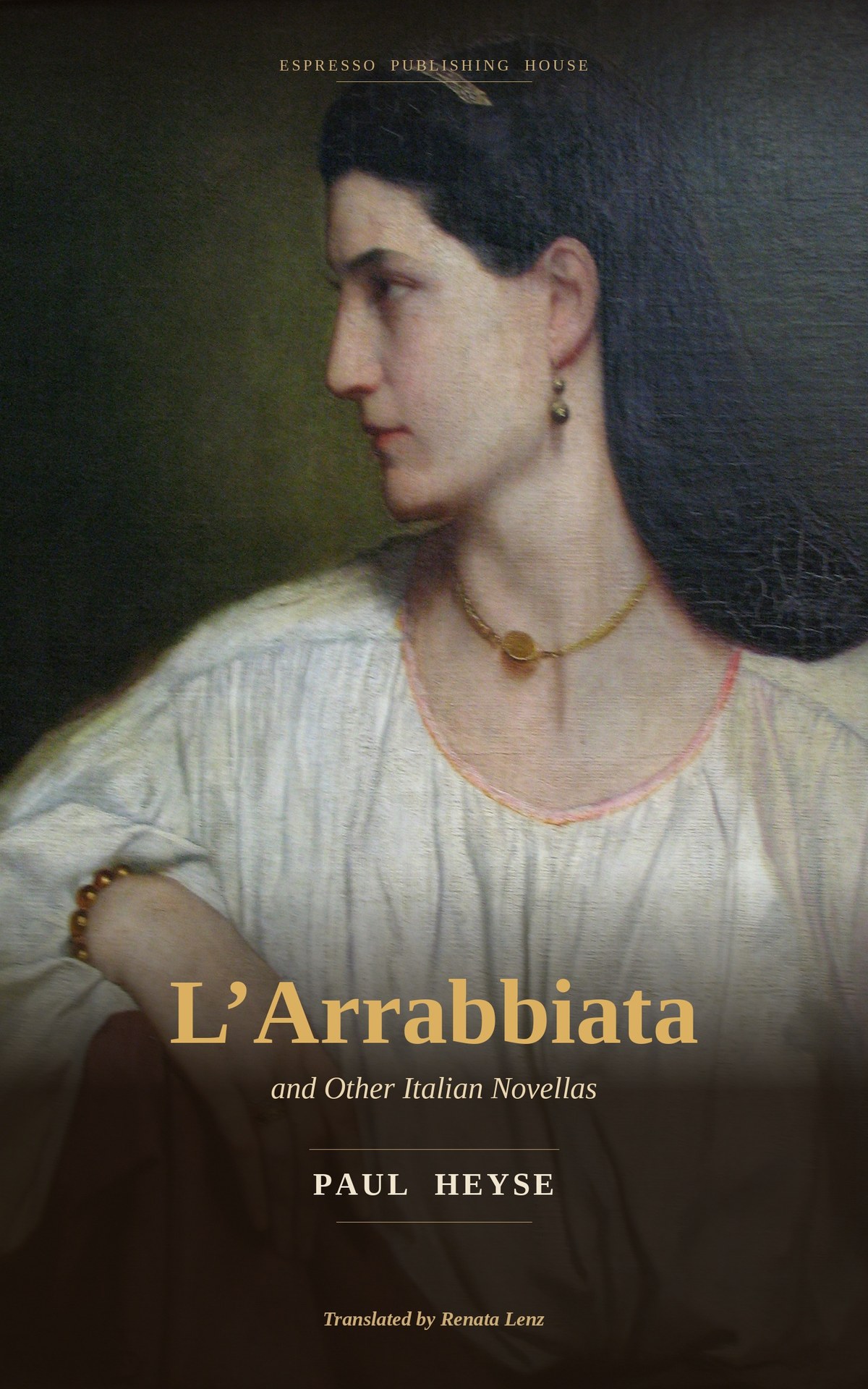
L’Arrabbiata and Other Italian Novellas
L’Arrabbiata, Die Stickerin von Treviso, Die Hochzeit auf Capri, Nerina · Paul Heyse, 1854 to the mid-1890s
Translated from the German by Renata Lenz
A silk-spinner crossing between Sorrento and Capri bites the hand of the boatman who has loved her for a year. In a walled workshop in Treviso, a banner worked in thread puts a woman in the sight of the man the whole city has turned out to see. On Capri, the man the bride did not marry toasts her at her wedding, drains his glass and lets it smash on the floor, and the word for a smashed glass becomes the word for what has happened to him. In the house at Recanati, a silk case holds one underlined line of poetry, and a young Giacomo Leopardi cannot say aloud what it means.
Heyse was a Berliner trained in Classics and Romance philology who moved to Munich at twenty-four and stayed until his death in 1914. Munich was only where he lived. Italy was where his imagination was, and he went back to it again and again: to Rome, to Naples, to the coast below Vesuvius, to the islands. His fisherfolk are not scenery and his Capri is not a postcard.
He was the most articulate theorist of the German Novelle as well as its most practised writer. His Falkentheorie, the Falcon Theory, comes out of Boccaccio’s story of Federigo, who sacrifices his prized falcon to honour the woman he loves: a true novella turns on the one thing specific enough to set it apart from a thousand others, with an outline you could cut from black paper and recognize whole. These four are studies in exactly that. In 1910 Heyse received the Nobel Prize in Literature.
This volume brings all four into English in a new translation made directly from the German by Renata Lenz, with an introduction by Idara Crespi on Heyse, the Falcon Theory, and an outsider’s Italy; her note on the translation; a biographical note on Heyse; story notes; and a glossary of the Italian his characters go on speaking inside his German sentences. Four complete stories in about a hundred and fifty pages.
The first book in Espresso German Classics. The paperback follows: join the readers’ list to hear when it goes on sale.