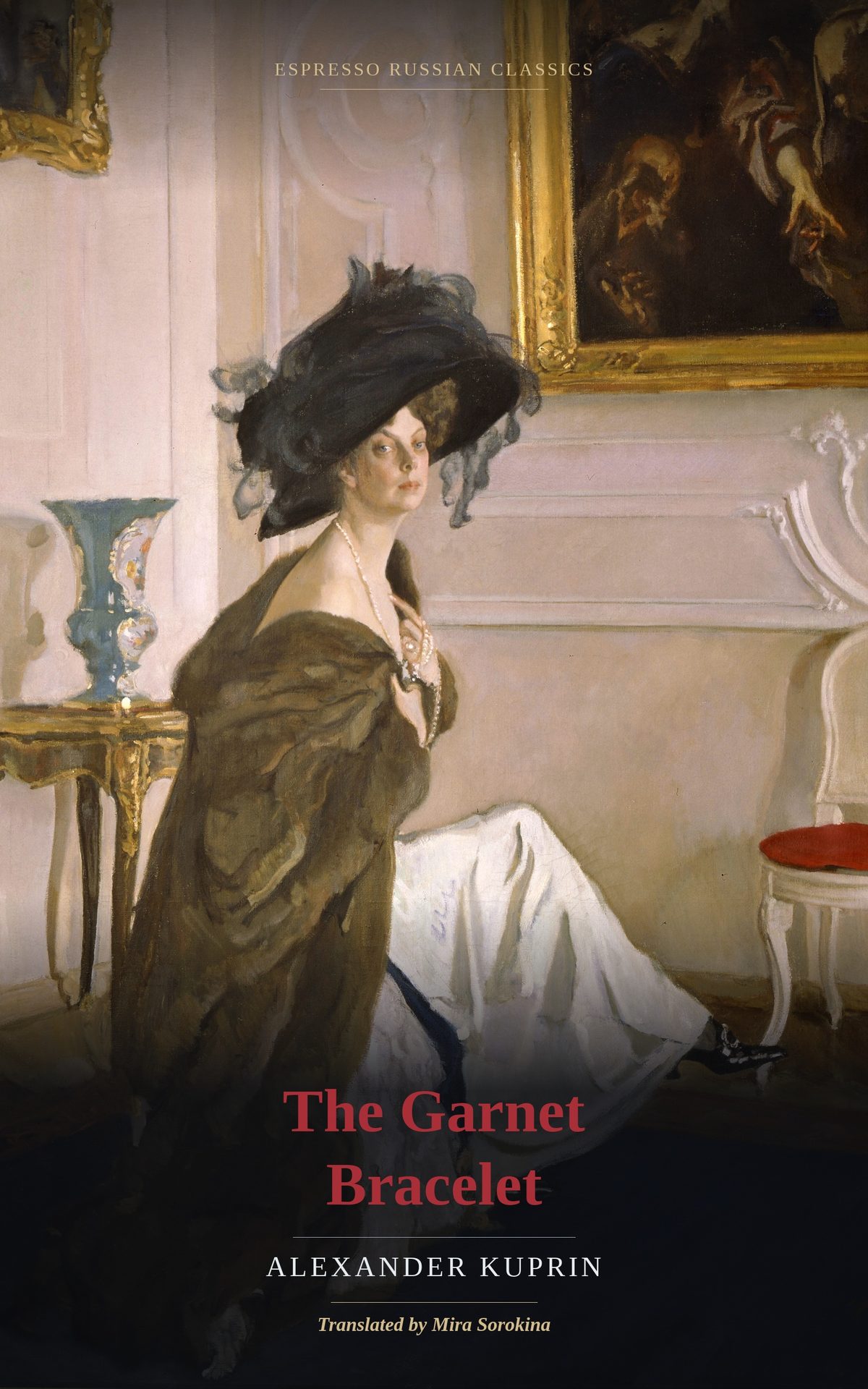
The Garnet Bracelet Forthcoming
Гранатовый браслет · Alexander Kuprin, 1911
Translated from the Russian by Mira Sorokina
For eight years a minor civil servant has been writing to a woman he has never spoken to. The letters are unsigned, or signed with initials only. Princess Vera Nikolaevna Sheina has never replied. She is married, aristocratic, entirely removed from his world. On her name day he sends her a garnet bracelet: a gold setting, five stones, one of them ringed by smaller ones that flash green in the right light. It is the last thing he will ever send her.
Her husband and her brother find out who he is. They go to see him and ask him, civilly, to stop. He agrees, and that night he takes his own life, leaving a final letter. Kuprin then gives Vera the last movement. She finds his rooms, looks at his face, goes home, and sits with Beethoven’s Second Sonata, the music he asked her in the letter to listen to. The Beethoven ends the novel. It is one of the most precise endings in Russian literature.
The Garnet Bracelet is a story about the kind of love that asks nothing in return and cannot be answered, told by a writer who understood that the feeling would carry the prose if the prose stayed out of its way. Most English versions of it reach the reader inside an anthology. This is its first standalone English edition.
This edition includes a new translation from the Russian by Mira Sorokina, an introduction by Idara Crespi, a translator’s note, and historical notes on Kuprin and on the Beethoven passage.
The first book in Espresso Russian Classics. A novella about a love that is never returned and never withdrawn, on sale from Valentine’s Day, 14 February 2027. The paperback follows at release.