Espresso Russian Classics
The Garnet
The Garnet
Bracelet
Гранатовый браслет
Translated from the Russian by Mira Sorokina · Introduced by Idara Crespi
Гранатовый браслет
Translated from the Russian by Mira Sorokina · Introduced by Idara Crespi
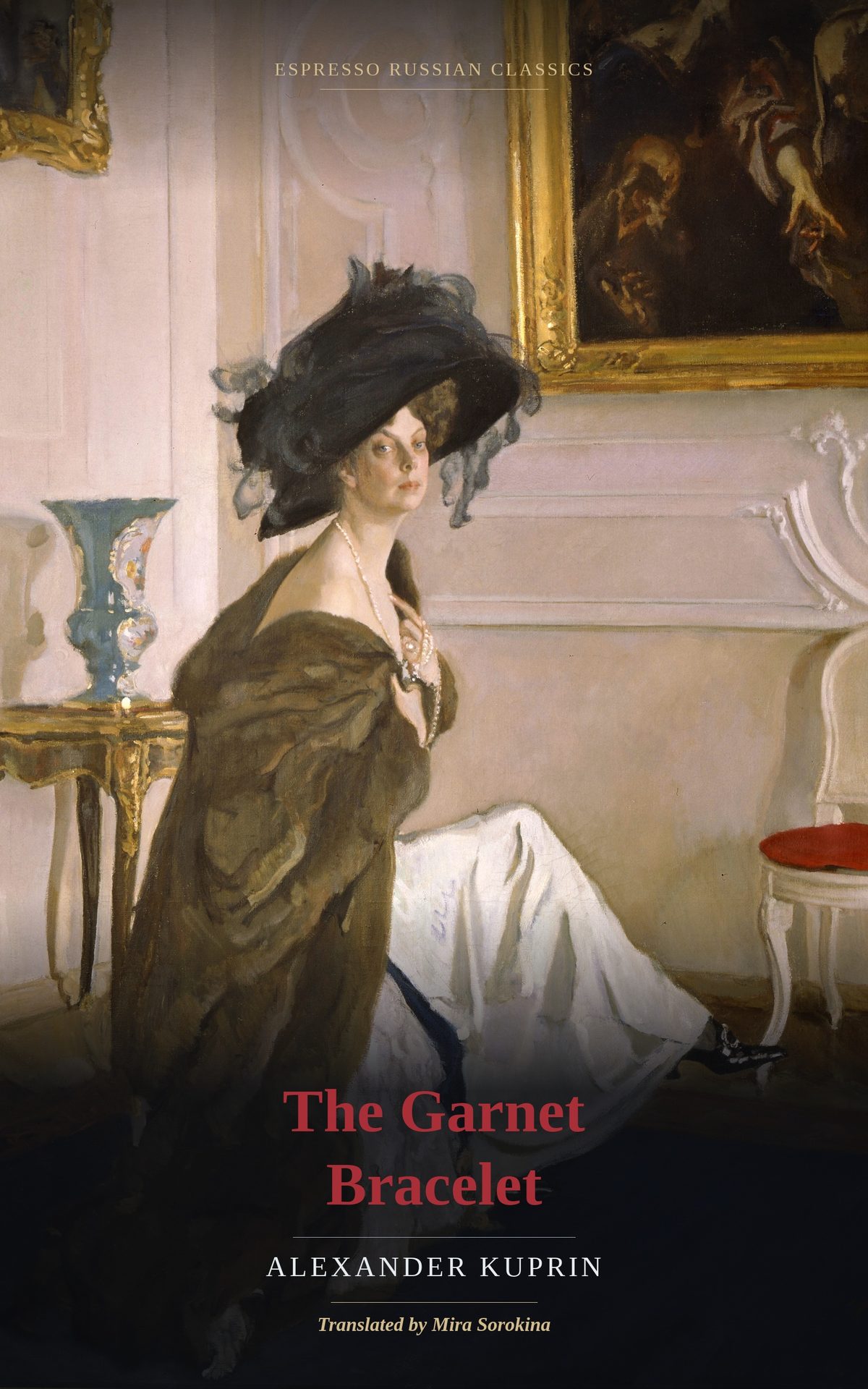
The first book in Espresso Russian Classics. A novella about a love that is never returned and never withdrawn, on sale from Valentine’s Day, 14 February 2027. The paperback ships on the same date.
For years a clerk Princess Vera Sheina has never met has written to her. On her name-day he sends her a garnet bracelet.
September on the northern shore of the Black Sea. The town house is still being repaired, so Vera has stayed on at the dacha, and her sister Anna comes out to help with the name-day guests. A parcel is left for Vera in the kitchen. Inside is a bracelet of low-grade gold covered in small garnets, with five cabochon garnets around a small green stone, and a letter signed G. S. Zh.
Late that night, walking old General Anosov to his carriage, Vera hears him ask where love has gone, the love that expects no reward, the love that is “strong as death.” Then she tells him about her correspondent. Perhaps, he says, it is exactly such a love that has crossed her path.
Her husband and her brother climb to the clerk’s rooms to hand the bracelet back and put a stop to the letters. Out of what follows, Kuprin makes a love story told from the far side, and he ends it with Vera on a garden bench while a friend plays Beethoven in the next room.
Alexander Kuprin (1870–1938) wrote The Garnet Bracelet in the autumn of 1910, mostly in Odessa, out of an anecdote from a St Petersburg household, and turned a drawing-room awkwardness into tragedy. It appeared in 1911, in the sixth collection of the almanac Zemlya, with a line of music as its epigraph: the Largo appassionato of Beethoven’s Piano Sonata Op. 2 No. 2. The same music closes the story.
Alexander Ivanovich Kuprin (1870–1938) was one of the major prose writers of the last Russian generation before the Revolution, admired in his lifetime alongside Chekhov and Bunin.
He was born in 1870 in Narovchat, a small town in the Penza province. His father, a minor government official, died when Kuprin was an infant; his mother, Lyubov Alekseyevna, descended from the Kulunchakovs, an impoverished line of Tatar princes, and brought him up in Moscow on very little. He was educated for the army, passing through the cadet corps and then the Alexander Military School, and served for several years as an infantry officer in the provincial garrison towns of the southwest, an existence of boredom, drink, and casual brutality that he would later anatomize in his novel The Duel.
Kuprin left the army in 1894 without a profession and spent the following years supporting himself by doing almost everything: reporting for provincial newspapers, surveying land, acting, working as a factory hand, an estate manager, a dental assistant, a fisherman on the Black Sea. That miscellaneous, hands-on knowledge of how the world actually works became the foundation of his fiction, which is prized for the precision of its physical detail and the warmth of its regard for ordinary people. His breakthrough came in 1905 with The Duel, an unsparing account of military life that made him briefly one of the most discussed writers in the country. Among his other enduring works are the Polesian romance Olesya (1898) and The Garnet Bracelet (1911), of which he said he had never written anything more chaste.
After the Revolution, Kuprin emigrated and lived for many years in Paris, where his work never quite found its footing in exile. Aging and gravely ill, he returned to the Soviet Union in 1937 and died in Leningrad on 25 August 1938. He is buried there, in the Volkovo Cemetery, near Turgenev.
He wrote a great deal across a long and unsettled life. He is remembered, above all, for a short novel about a love that asked for nothing and was recognized only after the man who felt it was dead.
Most readers outside Russia encounter Kuprin, if at all, as a minor figure in the shadow of Chekhov. Mira Sorokina would push back on that. And on the larger pattern it points to. The English-language reception of 19th- and early-20th-century Russian fiction has been shaped almost entirely by what fits on a shelf next to Tolstoy and Dostoyevsky, and the writers who don’t fit (Goncharov, Kuprin, Leskov, the early Bunin) have suffered for it. And the fitting happens in the English. A slow passage invites acceleration, a digression invites tidying, and underneath both sits an assumption that a reader wants the story and not the tempo. The slowness, she argues, is often the meaning. Mira is from Kazan, where Russian and Tatar, Orthodox and Muslim, European and Asian have coexisted for five centuries; the way a city looks at itself, she would tell you, is always a translation problem. She is the Russian literary translator for Espresso Publishing House.
Read more about the translators of Espresso Publishing House →
This Espresso Russian Classics edition is a new translation from the Russian by Mira Sorokina, with an Introduction by Idara Crespi, a Note on the Translation, a Note on the Text and a few endnotes.
Kindle ebook and paperback, 14 February 2027. ISBN 978-1-997077-06-0 (paperback).
Alexander Kuprin · Translated from the Russian by Mira Sorokina · 14 February 2027