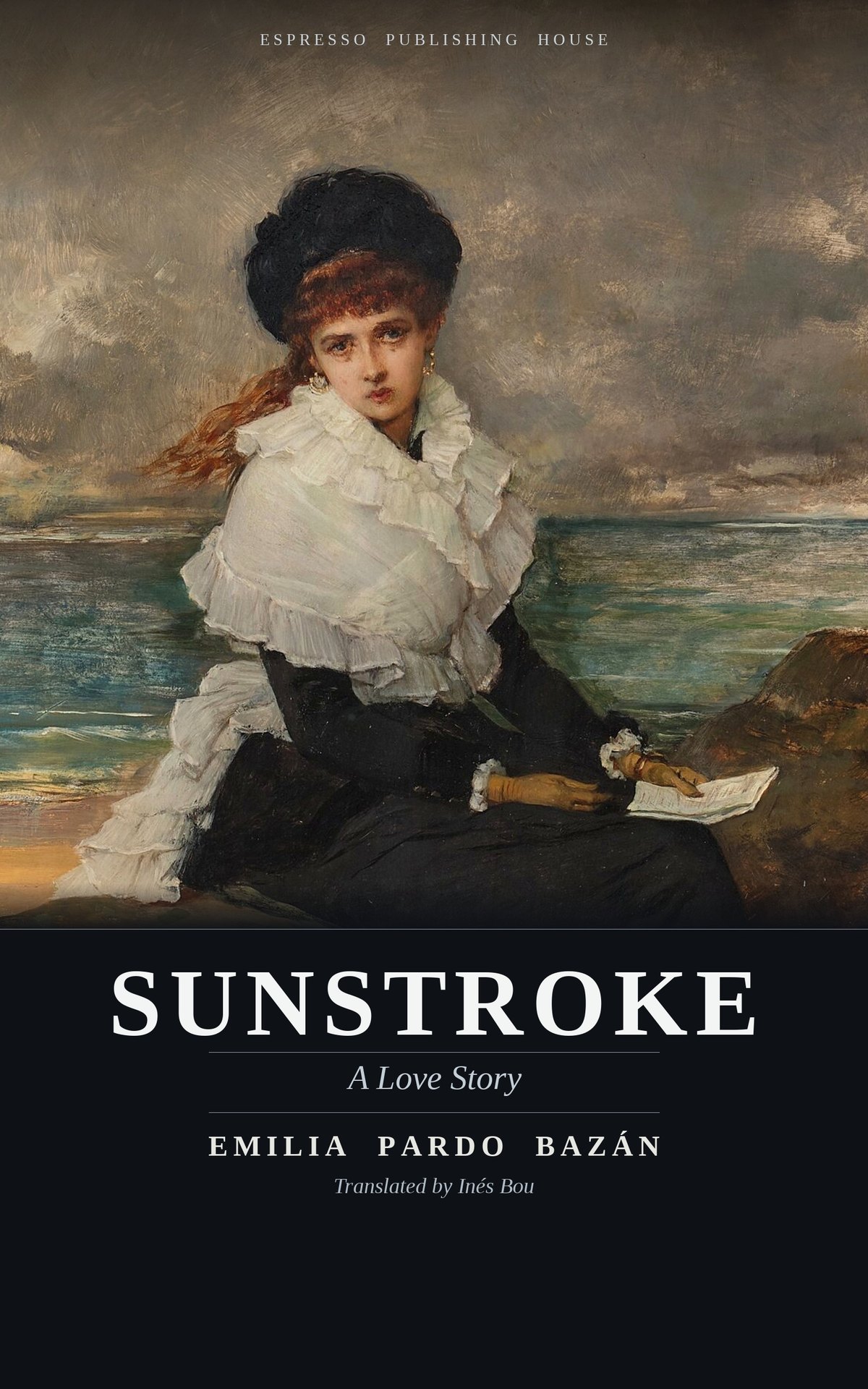
Espresso Spanish Classics
Sunstroke
Sunstroke
A Love Story
Insolación
Translated from the Spanish and introduced by Inés Bou
Insolación
Translated from the Spanish and introduced by Inés Bou
Sunstroke: A Love Story goes on sale 6 January 2027, in Kindle and paperback. Join the readers’ list to hear the day it does.
A woman wakes in a darkened Madrid bedroom with her head splitting, orders lime-blossom tea, and begins composing the account she will have to give her confessor. Her maid has already supplied the opening line of it: too much sun. Asís Taboada, the widowed Marquesa de Andrade, thirty-two years old with her two years of mourning behind her, is willing to believe her.
What happened was the feast of San Isidro. She had gone out to Mass with her prayer book and her mantilla, run into an Andalusian gentleman she had been introduced to the night before, and let him take her across the Toledo Bridge to the fairground on the meadow. Dust, and mechanical pianos hammering the same paso doble at her from thirty spots at once. Carnations the colour of bull’s blood. The smell of frying buñuelos catching in the throat. A gypsy woman who reads her palm for a peseta. And a bottle labelled Manzanilla Superior that tastes of esparto grass, alum and crowned devils. Asís drinks it anyway.
A Love Story is Pardo Bazán’s own subtitle, not ours: she put Historia amorosa on the 1889 title page. It is the driest joke in the book. Sunstroke is a very funny novel, and the comedy is not in the seduction. It is in the distance between what Asís does and what Asís is prepared to admit she has done. Pardo Bazán gives her a conscience that answers back, an inflexible interior voice that declines to accept the weather as a defence and calls her excuses what they are: the excuses of a bad payer. We watch a respectable woman build her own alibi in real time, one clause at a time, and we watch it come apart in her hands.
For readers of Eça de Queirós, Machado de Assis and Guy de Maupassant.
Emilia Pardo Bazán published the novel in 1889 and was attacked for it. She was a countess and a public intellectual, the first woman in Spain to hold a university chair, and three times denied a seat in the Real Academia Española. She had spent the decade arguing in print for naturalism, which her critics called a foreign import and a danger to Spanish letters, and here she turned it on a woman of her own class and let her live.
She is an unknown quantity to most readers who meet her in English. Sunstroke is the shortest and the funniest way in.
Inés Bou translates the Espresso Spanish Classics list. Her translation of Pedro Antonio de Alarcón’s The Three-Cornered Hat opened the series in May 2026.
Her translation of Insolación is made from the Spanish throughout. It carries Asís’s double voice, the formal Galician-bourgeois performance and the running private commentary underneath it, held in the same sentence. It renders Diego Pacheco’s southern speech in diction and rhythm rather than in dropped letters and phonetic spelling. It gives the fortune-teller a heightened, incantatory English that keeps her cadence without mimicking her. And it leaves the material culture of 1889 Madrid in Spanish where an English word would flatten it, glossed on first appearance: the romería, the merienda, the chulos planted on the pavement outside the Café Suizo.
This Espresso Publishing House edition includes an introduction by Idara Crespi placing the novel in Pardo Bazán’s career and in the Spanish quarrel over naturalism, a Translator’s Note, Historical Notes on the San Isidro festival and the Madrid of 1889, a Glossary of madrileño material culture, and explanatory notes throughout.
Asís spends the whole book blaming the sun. The sun is the only party to the business that never answers back.
Emilia Pardo Bazán · Translated from the Spanish by Inés Bou · 6 January 2027