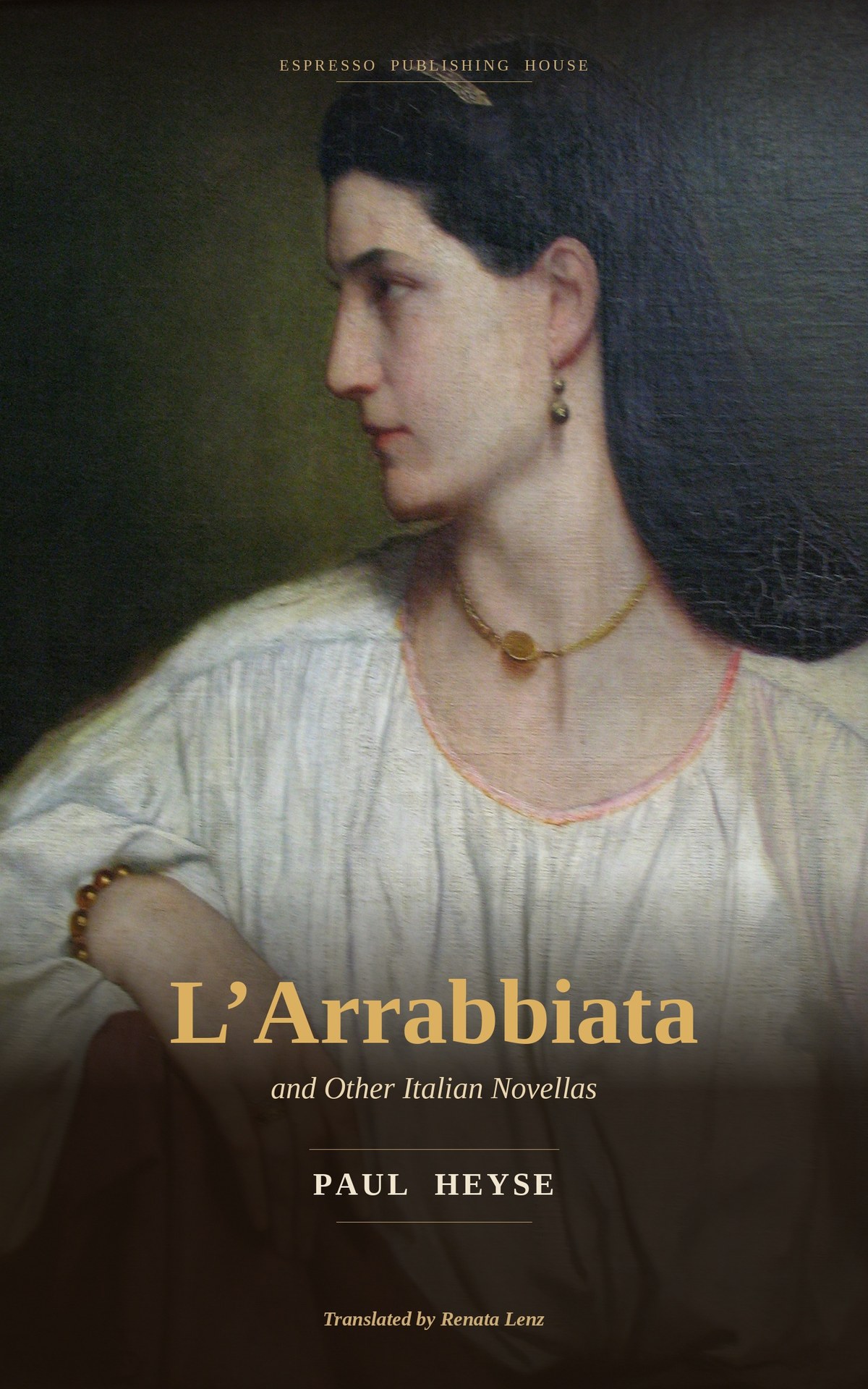
The first book in Espresso German Classics. Kindle ebook, publication date 1 October 2026. The paperback follows.
About the book
A silk-spinner crossing between Sorrento and Capri bites the hand of the boatman who has loved her for a year. In a walled workshop in Treviso, a banner worked in thread puts a woman in the sight of the man the whole city has turned out to see. On Capri, the man the bride did not marry toasts her at her wedding, drains his glass and lets it smash on the floor, and the word for a smashed glass becomes the word for what has happened to him. And in the house at Recanati, a silk case holds one underlined line of poetry that a young Giacomo Leopardi cannot say aloud.
Paul Heyse called the hinge of every true novella its falcon: the one thing specific enough to set a story apart from a thousand others, with an outline you could cut from black paper and recognize whole. The four stories collected here are studies in exactly that.
He was a Berliner, trained in Classics and Romance philology, who moved to Munich at twenty-four and lived there for the rest of his life. Munich was only where he lived. Italy was where his imagination was, and he went back to it for decades: to Rome, to Naples, to the coast below Vesuvius, to the islands. He wrote about that country the way a person writes about a place that has entered the nervous system and will not leave. His fisherfolk are not scenery. His Capri is not a postcard.
The prose is the reason to read him, and it is not what an English reader expects from a nineteenth-century German. It is warm and physically alert, fast and economical, exact about light and water and faces and hands. He ends on the beat where a lesser writer would add three pages of consolation. His fishermen and grandmothers and island girls talk like people rather than like a costume drama. And he lets his Italians go on speaking Italian inside his German sentences, exclaiming and praying and insulting each other in a language he refused to smooth away.
The four novellas
L’Arrabbiata (the yearbook Argo, Dessau, 1854)
Laurella, called the angry one, crosses to Capri and back in the skiff of a young boatman who has waited a year for her to speak to him. Heyse met the story at Sorrento in 1853, at twenty-three. It is the story that made his name.
The Embroiderer of Treviso (Der Salon, Leipzig, 1869)
A banner worked in a walled workshop for a man its maker has never seen.
The Wedding on Capri (Melusine und andere Novellen, Berlin, mid-1890s)
An island wedding, a toast from the man the bride did not marry, and a glass that smashes on the floor.
Nerina (collected in Neue Novellen, Berlin, 1875)
Recanati, the Leopardi house, a silk case, and one underlined line of verse.
Paul Heyse
Paul Johann Ludwig Heyse (1830–1914) was born in Berlin, the son of the philologist Karl Wilhelm Ludwig Heyse and of Julie Saaling. His father had spent eight years as private tutor in the Mendelssohn Bartholdy household, with Felix among his pupils; his mother was a cousin of Felix’s mother. He studied Classics and Romance languages in Berlin and Bonn, completed a doctorate, and might have stayed an academic. Then he went to Italy.
He met the story at Sorrento in 1853, and L’Arrabbiata appeared the following year in the yearbook Argo. By then the rest of his life had been arranged for him elsewhere. King Maximilian II of Bavaria had set out to gather the finest writers and intellectuals of Germany at his court in Munich, and the king’s literary adviser, the poet Emanuel Geibel, put forward the name of a gifted and almost entirely unknown twenty-four-year-old. The invitation came in March 1854. Heyse accepted, and arrived in Munich that May. He would spend the rest of his life there, until his death in 1914, travelling to Italy again and again in the decades between.
His output was enormous: novels, plays, poetry, and the Italienisches Liederbuch of 1860, several hundred Italian folk poems he had put into German himself, which Hugo Wolf would later set to music. But the Novellen, in the precise German sense of the word, were where he excelled. He was the most articulate theorist of the form as well as its most practised exponent, and his Falkentheorie is drawn from Boccaccio’s story of Federigo, who sacrifices his prized falcon to honour the woman he loves.
In 1910 Heyse received the Nobel Prize in Literature, awarded, in the Academy’s words, “as a tribute to the consummate artistry, permeated with idealism, which he has demonstrated during his long productive career as a lyric poet, dramatist, novelist and writer of world-renowned short stories.” It is a citation that reads like a summing-up, which is what it was. He was eighty when the prize was announced. He died three and a half years later.
Renata Lenz, translator
Renata Lenz is a literary translator working from German into English. Her subject is the German Poetic Realists, Storm and Fontane and Keller, and above all Paul Heyse, whose disappearance from English-language reading lists has been her long-running preoccupation. Her working conviction, and the reason she came to him, is that the books were never the problem.
She drafts fast and revises slowly. The revision takes the greater part of any project: she reads aloud against the German until the two texts agree about what kind of sentence this is. She keeps a running log of the compound nouns she meets, on the theory that the words with no English behind them are the ones that tell you what a writer actually notices. And she will tell you, on the page, which of her own choices she is still not sure about. A translation that hides its decisions is asking to be trusted for the wrong reasons.
She is from Freiburg im Breisgau, which bought itself free of its counts in 1368, handed itself to the Habsburgs, and spent the next four and a half centuries at the far western edge of the empire that owned it. The city has never entirely settled the question of what it belongs to, and she has never entirely trusted writers who cannot tolerate ambiguity. L’Arrabbiata and Other Italian Novellas is her first translation for Espresso Publishing House.
Read more about the translators of Espresso Publishing House →
This edition
This Espresso Publishing House edition is a new translation made directly from the German source texts. It carries an introduction by Idara Crespi on Heyse, the Falcon Theory, and an outsider’s Italy; Renata Lenz’s note on the translation; a biographical note on Heyse; notes on the individual stories; and a glossary of the Italian his characters speak inside his German sentences.
Four complete stories in about a hundred and fifty pages. An evening or two, not a season.
Cover art: Anselm Feuerbach, Nanna (1861).
Kindle ebook, publication date 1 October 2026. The paperback follows.